After the abduction of Mata Sita by the demon king Ravana, Shri Rama and his younger brother Lakshmana wandered the forests in search of her. Their grief was immeasurable, but Rama moved forward with steady resolve, asking the trees, the rivers, the mountains — had anyone seen his beloved?
Their path brought them to the region near Rishyamukh Parvat — a sacred mountain in the Kishkindha forest, home to the vanar king Sugriva, who lived there in exile, having been wrongly driven out by his elder brother Bali.
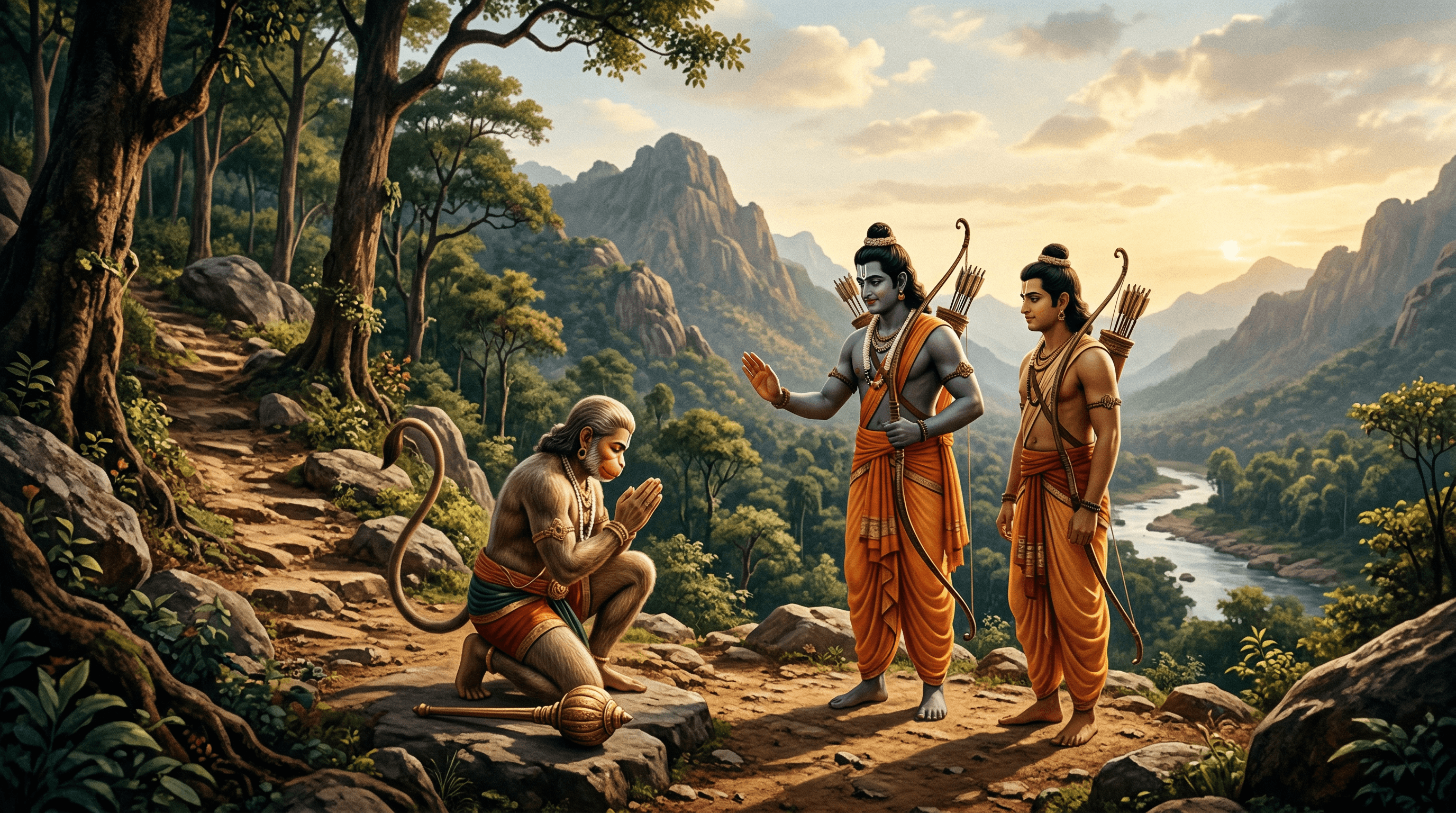
Sugriva, watching from the mountain with his minister Hanuman, saw two young men walking through the forest below. They were tall, radiant, carrying bows, their bearing like that of princes — yet they were dressed as forest wanderers. Sugriva was anxious. Were these men sent by Bali to harm him?
He turned to Hanuman and said: "Go and find out who these two are. Go in the guise of a common wanderer."
Hanuman descended from the mountain, having taken the form of a young scholar-brahmin, his bearing calm and scholarly. He approached the two strangers with folded hands and spoke in the most refined Sanskrit — each word chosen with precision, each sentence composed with grace.
Rama listened. Then he turned to Lakshmana and said quietly: "This person before us — listen to how he speaks. Each word is correct, each tone is measured, each thought is clear. There is no error in his speech, no hesitation in his manner. Such mastery of language is the mark of true learning. I see no weakness in him."
These words of Rama — spoken before he even knew who Hanuman was — were a recognition that would matter forever to Hanuman.
Hanuman then introduced himself honestly and asked who the two wanderers were. Rama replied, introducing himself and Lakshmana, and explained their painful circumstances — the loss of Mata Sita, their long wandering. His voice was steady but his grief was real.
Something happened in that moment in Hanuman's heart. He had spent his entire life waiting — for a purpose worthy of his strength and devotion. And now, before him, was Shri Rama.
Hanuman's form as a scholar-brahmin fell away. He revealed himself — the son of Vayu, the servant of King Sugriva, a vanar of extraordinary power. He folded his hands and bowed before Shri Rama with complete surrender.
Rama looked at him with recognition — the kind of recognition that goes beyond the eyes. He embraced Hanuman as one embraces a long-separated companion whose absence one has felt without knowing what was missing.
From this moment, Hanuman's life had its axis. Everything before this was preparation. Everything after would be devotion.
He carried Shri Rama and Lakshmana on his shoulders up to meet Sugriva. The alliance between Sugriva and Rama was formed. The search for Mata Sita would begin in earnest.
But in this first meeting — in the quiet recognition of a wandering prince and a brilliant vanar on a mountain path — the most celebrated friendship in all of Hindu sacred literature had begun.
When Tulsidas wrote the Hanuman Chalisa centuries later, his first description of Hanuman was: *"Jai Hanuman, Gyan Gun Sagar"* — Hail Hanuman, the ocean of wisdom and virtue. It was Rama himself who first recognized that wisdom, on that forest path, before he even knew the vanar's name.