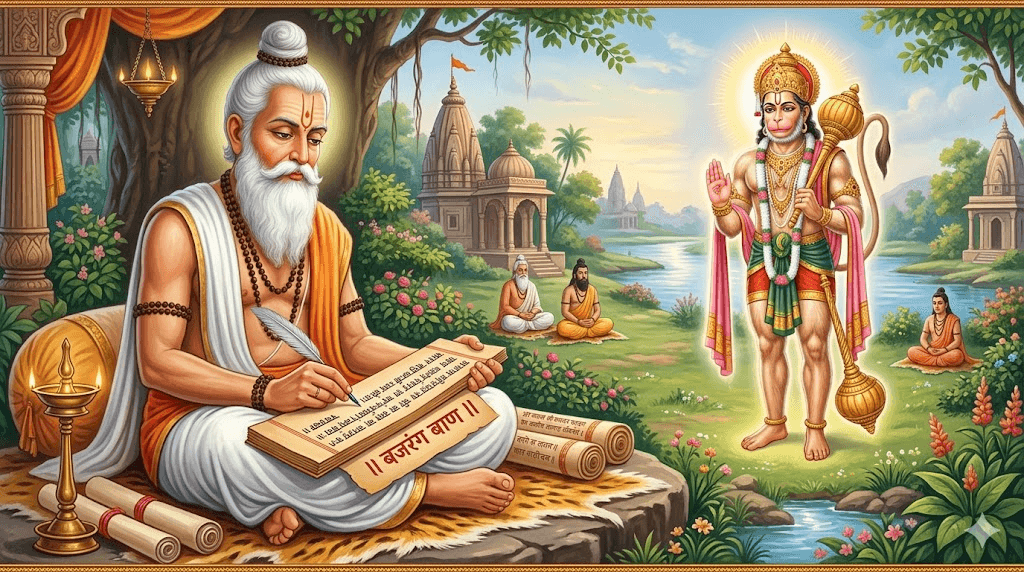
Goswami Tulsidas spent most of his life in Varanasi and Ayodhya — composing, reciting, and living the Ramayan. By the time he was old, he had produced works of extraordinary depth: the Ramcharitmanas, the Hanuman Chalisa, the Vinaya Patrika, and many others. He was widely revered, and in being revered, he had also attracted envy.
The accounts of what happened vary in detail, but their essence is consistent: a powerful negative force — described variously as a practitioner of dark arts, an evil spirit, or an adversarial deity — began tormenting Tulsidas. The torment was not physical at first: it was a presence, a pressure, a disruption of his peace that no prayer he knew seemed to quiet.
He prayed to Rama. He recited the Chalisa. He performed puja. The disturbance continued.
Then, in the depths of one particularly terrible night, he turned not to the serene Rama but to the fierce Hanuman — not the gentle devotee but the warrior, the protector, the one who had burned Lanka and broken the backs of giants. He needed not comfort, but combat.
What emerged from his pen that night was different from anything he had written. The Bajrang Baan — literally, "the arrow of Bajrang" — was not a song of praise but a direct address: urgent, commanding, invoking Hanuman not as a distant deity but as an immediate force. The language was charged with power. Each verse functioned as a weapon aimed at whatever darkness had taken hold.
The tradition holds that as Tulsidas recited these verses, the torment ceased. Whatever had been pressing on him withdrew. The night became quiet.
Tulsidas understood, perhaps, that this was not because of any magic in the words — but because in that extremity, his devotion had reached a new depth. Fear had stripped away every pretence and left only honest, urgent prayer. And honest, urgent prayer, directed to Hanuman, is never unanswered.
The Bajrang Baan is today recited not for its poetic beauty — it lacks the graceful metre of the Chalisa — but for the same reason it was first composed: by those who are afraid, who are under siege, who need the warrior-face of devotion to stand beside them in the dark.
Tulsidas gave them the words. Hanuman does the rest.