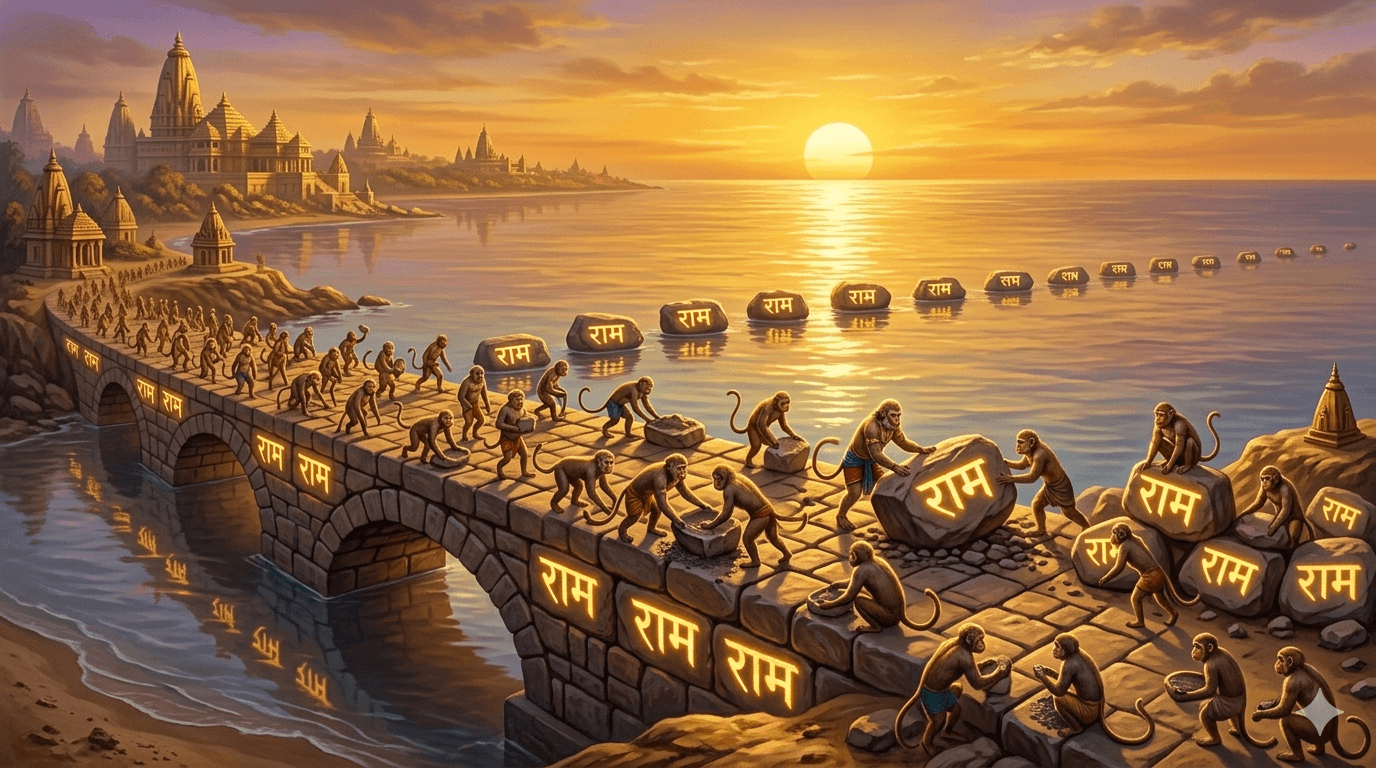
The army had assembled at the southern shore of India. Before them lay the ocean — vast, hostile, the domain of Varuna the sea god. On the other side, invisible beyond the horizon, was Lanka. Between the army and Lanka stood water that no bridge had ever crossed.
Nala, the son of the divine architect Vishwakarma, was among Sugriva's vanars. He had the gift of his father's hands: whatever he touched and placed in water with intention would float. He began to direct the construction.
The vanars worked with extraordinary energy — uprooting trees, carrying mountains of stone, singing the name of Rama as they worked. They inscribed the name on every stone before placing it in the water.
Here the tradition offers a moment that is at once simple and inexhaustible in meaning.
When Hanuman placed a stone in the water, it floated. When Rama himself, curious, picked up a stone and placed it gently in the water — it sank.
The gods watching from above were puzzled. Hanuman was asked about this. His answer has been remembered for thousands of years.
"That which Rama holds in his hand," he said, "is already separated from Rama. The name of Rama, written on the stone, keeps it in Rama's presence. How can what is held by Rama's hand be with Rama, if Rama's hand is what separates it from him?"
The teaching cuts to the centre of devotion: it is not proximity to the divine in a literal sense that saves — it is the name, the remembrance, the constant turning of the heart toward the sacred. A stone written with Ram Naam is closer to Rama than a stone held in Rama's hand.
The bridge took five days. It stretched from the shores of India to the island of Lanka — one of the great engineering feats described in any scripture, built by an army of vanars, stone by stone, name by name.
Today the Ram Setu — the chain of limestone shoals connecting India and Sri Lanka — remains in the ocean. Scientists date the formation to ancient times. Pilgrims know it by a different accounting.
It was built on the name. It stands on the name. As everything built in faith does.